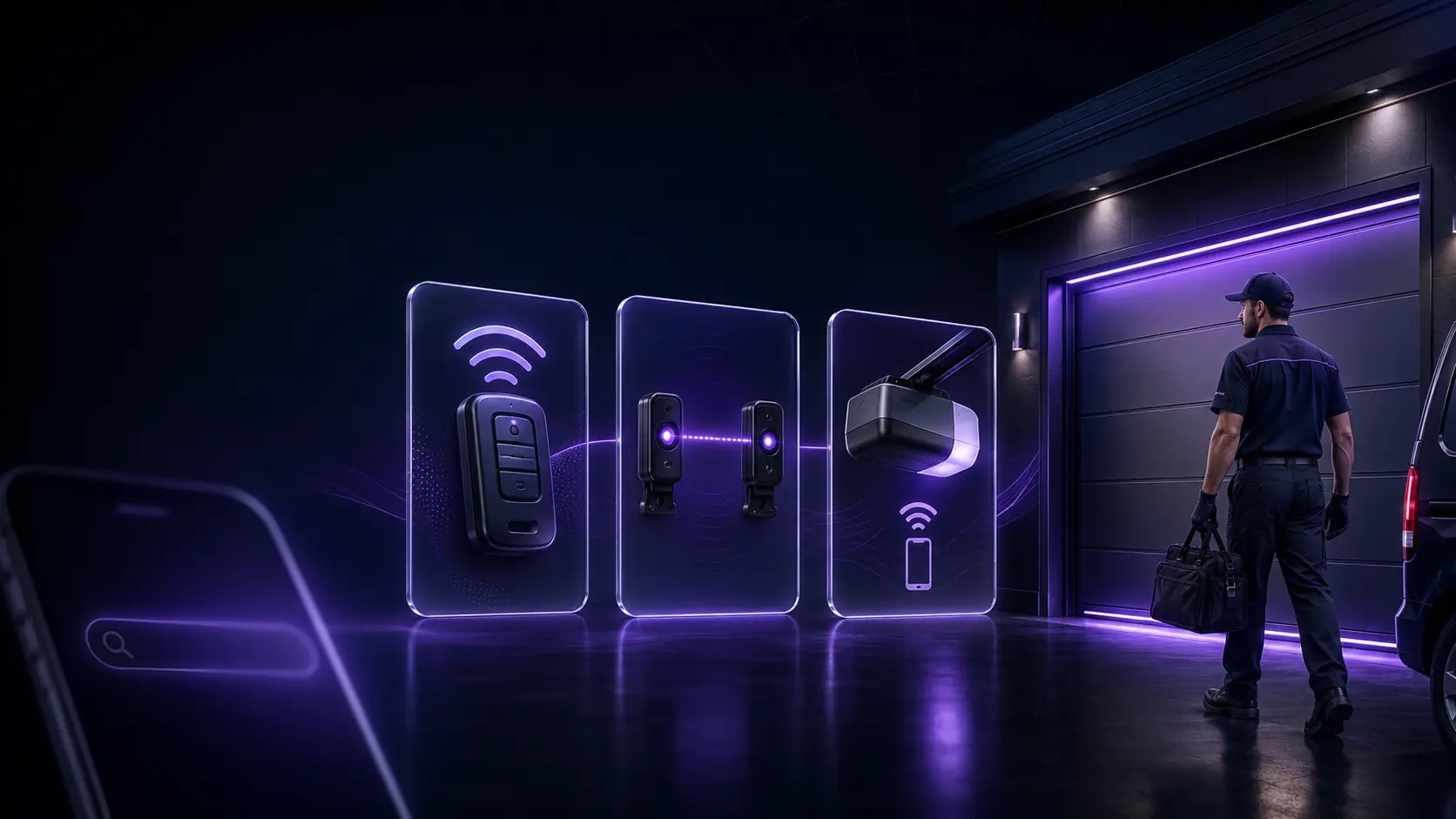
A homeowner whose remote stopped working is not necessarily looking for the same service as someone whose door reverses, strains, or has an obsolete opener. Yet many garage door websites send every opener search to one thin page. The result is confusion, unsafe self-diagnosis, poorly qualified calls, and lost replacement opportunities. A better page routes symptoms without pretending to diagnose the system online.
01
The answer: organize the page around decisions, not a keyword list
Build one opener service page that helps a visitor identify the category of problem, understand the safety boundary, see what the company actually services, compare repair with replacement when appropriate, and request the right appointment. The page should reduce uncertainty without claiming that one symptom proves a specific failed part.
An opener is connected to a complete door system. Control problems, sensor conditions, power loss, obstructions, damaged hardware, broken springs, opener components, and compatibility limits can produce overlapping descriptions. A search phrase is not a diagnosis.
EdgeLocal viewpoint: the best opener page does not chase every troubleshooting variation. It creates a truthful route from symptom to safe next step, then measures qualified calls, booked service, repair-versus-replacement outcomes, and profitable completed work.
02
Separate the five opener journeys before writing copy
Start with the visitor’s language. Remote and wall-control searches usually need different questions from a door that reverses or refuses to close. Noise and strain searches may involve the opener, the door, or both. Smart-access searches introduce model, accessory, app, account, and network compatibility. Older-unit searches often combine safety, reliability, features, parts availability, and replacement cost.
Audit the page against those journeys. “We repair all openers” does not tell the reader what information to gather or what the company can provide. Publishing dozens of unsupported causes creates false confidence, while a name-and-phone-only form gives dispatch little routing context.
Create conditional symptom sections. Ask for the safely visible brand or model, which controls work, door behavior, warning lights or sounds, and any impact or power interruption. Never ask someone to remove covers, enter a hazardous area, or operate an unstable door.
03
Make safety part of the commercial answer
Automatic residential garage door operators sold in the United States are governed by the federal safety standard in 16 CFR Part 1211. CPSC explains that operators manufactured on or after January 1, 1993 must meet additional entrapment-protection requirements. CPSC also advises testing the reversing feature according to the manufacturer’s recommendations and having the system professionally inspected when it fails to reverse.
A service page should state the boundary plainly: do not bypass safety sensors, defeat auto-reverse protection, or increase force to compensate for a door that does not move correctly. Do not publish homeowner instructions for adjusting springs, cables, tracks, or door balance. DASMA and manufacturer manuals are appropriate sources for safe owner checks; model-specific professional work belongs with a qualified garage door technician.
Safety language is part of trust and qualification. An off-track door, broken spring or cable, uneven movement, or unstable position needs a different next step from a remote issue. Link dangerous symptoms to the broken-spring safety guide and urgent-call conversion path.
04
Explain repair versus replacement without forcing the sale
A useful page explains the factors a technician may evaluate: safety performance, opener and door condition, model support, parts availability, previous failures, installation quality, warranty, noise goals, lighting, battery backup, smart-access needs, and the cost and durability of the available repair. No single age threshold or symptom should be presented as a universal verdict.
List only the brands and opener types the company genuinely services. Smart controls, cameras, battery backup, drive types, wall-mount configurations, accessories, and connectivity vary by model and installation. Link manufacturer documentation instead of promising universal compatibility.
Connect price questions to the repair-cost transparency framework, and connect whole-door projects to the replacement buyer journey. The opener page should help the buyer reach the correct branch, not absorb every garage door topic into one oversized page.
05
Show the evidence that makes a service call feel safe
Explain what happens after contact: intake, safe-use guidance, appointment window, assessment, options, authorization, work, system testing, walkthrough, and warranty. State availability and response times accurately; never imply 24-hour service when it is not offered.
Support the process with real technician credentials where applicable, authentic opener-related reviews, manufacturer or dealer relationships that can be verified, and original photos of the team or equipment used with permission. Never imply authorization the company does not hold or present an AI-generated scene as completed customer work. The review integrity system can help organize trustworthy evidence.
Google’s structured-data guidance requires markup to represent visible page content and warns that correct markup does not guarantee a rich result. Keep business hours, telephone, service descriptions, reviews, and other structured facts aligned with what users can see and what the operation actually delivers. Do not invent ratings, prices, availability, or service areas.
06
Measure the opener funnel separately from generic repair
Track opener-page visits, symptom-section engagement, calls, forms, qualified leads, booked appointments, repair-versus-replacement recommendations, approved work, completed jobs, revenue, gross profit, and lost reasons. Segment remote or control issues, safety-sensor or closing issues, motor or drive concerns, smart-access requests, and replacement opportunities when the data is reliable enough to act on.
Use the call-tracking governance guide to protect the permanent phone identity while measuring campaigns. Review queries and call classifications together. If reset searches produce few serviceable calls, improve the intent boundary; if replacement inquiries are common, strengthen that booking path.
A smaller, better opener page can outperform a cluster of thin pages for every brand, symptom, and city because it concentrates useful evidence and internal links. Create a separate page only when the new intent, service, market, and proof are genuinely distinct. The website and Google Business Profile should describe the same real opener services and coverage.
Reviewed August 1, 2026. CPSC, DASMA, LiftMaster, and Google sources support the safety, product-category, search, and structured-data facts. The Opener Intent Routing Board and commercial recommendations are EdgeLocal analysis. Models, compatibility, codes, warranties, parts, and service procedures vary; follow the specific manufacturer documentation and qualified professional guidance. Rankings, calls, bookings, and revenue are not guaranteed.
Sources and methodology
Sources checked for this guide
Source links support the platform, search, or safety facts stated above. The diagnostic framework and commercial recommendations are EdgeLocal analysis.
- U.S. CPSC: Automatic Residential Garage Door Operators
- U.S. CPSC: Final rules for automatic garage door openers
- DASMA: Garage Door Opener Safety Tips
- LiftMaster: Garage Door Opener Repair and Maintenance
- Google Search Central: Creating helpful, reliable, people-first content
- Google Search Central: General structured data guidelines
Value the qualified service demand
Measure opener calls by the work they become.
Use the free ROI calculator with your opener-related qualified leads, booking rate, average job value, gross margin, and plan cost. Traffic is useful only when the right jobs reach the schedule.
Run the free ROI calculator