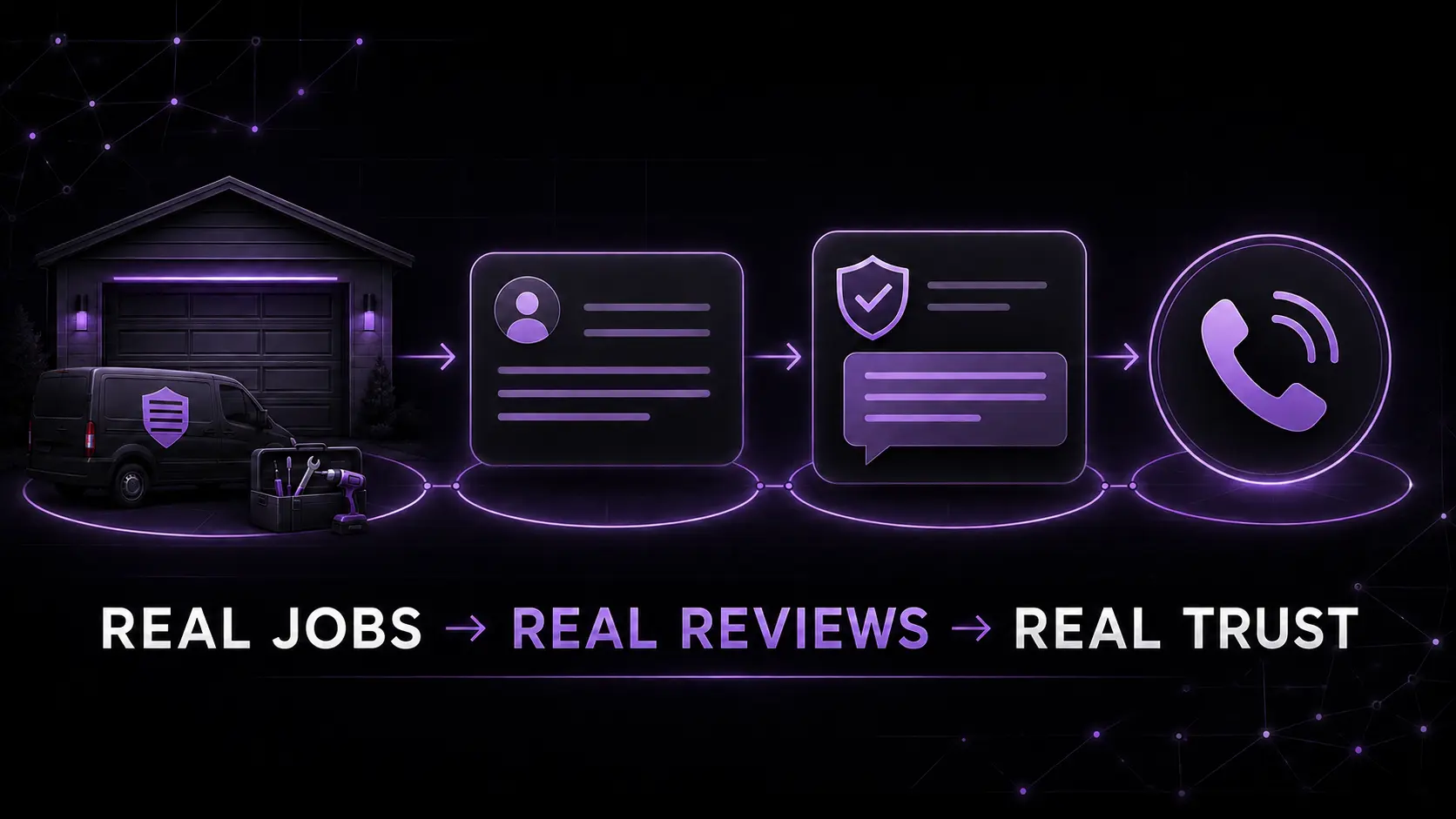
A garage door company can finish excellent work every day and still have a thin, outdated review profile. The usual problem is not customer satisfaction. It is an inconsistent request process. The right fix is a neutral, repeatable workflow that asks real customers for honest feedback, makes the request easy, responds professionally, and never depends on incentives or filtering for happy customers.
01
The answer: build a workflow, not a review campaign
A review campaign is usually a temporary push: the team remembers to ask for two weeks, the count rises, and the process disappears. A review workflow attaches one neutral request rule to a real operating event, such as a completed and paid service call. It runs consistently whether the job was a broken-spring repair, opener replacement, cable service, or new-door installation.
Google says businesses can encourage customers to leave reviews by sharing a review-request link or QR code. That makes the mechanics simple. The harder part is defining who receives the request, when it goes out, and how the company handles every kind of response.
EdgeLocal viewpoint: the goal is not to manufacture a perfect rating. It is to create a trustworthy body of customer evidence that reflects the services and markets the company genuinely handles. A smaller flow of authentic reviews is more defensible than a sudden burst produced by a shortcut.
02
Ask at the moment the customer can evaluate
The best trigger is a completed experience, not a calendar reminder. Send the request after the technician has finished the work and the customer has had a clear chance to evaluate the result. If the job requires a return visit or an unresolved part order, wait until the service is actually complete.
Use the same eligibility rule for every qualifying customer. A simple version is: completed residential service, valid contact permission, no unresolved safety or billing issue, and no duplicate request within a defined period. This is operational filtering, not sentiment filtering.
Do not make the technician guess who seems happy enough to ask. That creates an inconsistent system and can become review gating: routing satisfied customers toward a public review while directing unhappy customers somewhere private. Collect private feedback from everyone if it helps service recovery, but do not use it as a gate that decides who receives the public-review option.
03
Make the request neutral and easy
A useful request is short: thank the customer, ask for an honest review, provide the direct link, and stop. Do not supply a five-star instruction, suggested praise, or a list of keywords the customer should mention. The experience belongs to the reviewer.
Google notes that service-business reviewers may be asked to identify the specific service provided, and that selection can appear with the written review. Keep the Business Profile service list accurate so the platform and customer see the same real service offering.
One text message or email is often enough. If the customer does not respond, one polite reminder can be reasonable when it fits the company’s communication consent and local requirements. Repeated chasing turns a trust request into friction.
- Thank the customer for choosing the company.
- Ask for an honest review of the completed service.
- Use the official Google review link or QR code.
- Give the customer room to describe the experience in their own words.
04
Keep incentives away from Google reviews
Google describes incentivized reviews as ratings influenced by payment, discounts, free goods or services, or another benefit, and says these arrangements undermine content integrity. For a Google review request, do not offer a rebate, gift card, contest entry, free tune-up, or future discount.
The FTC’s Consumer Reviews and Testimonials Rule, effective October 21, 2024, adds a separate U.S. legal layer. FTC guidance explains that an incentive cannot be conditioned on a positive or negative sentiment and that undisclosed incentives may create other legal problems. The FTC also prohibits buying fake reviews and suppressing honest negative feedback through certain deceptive or intimidating tactics.
Platform rules and federal law are not identical. A practice that might be structured lawfully in one context can still violate a platform’s review policy. EdgeLocal’s practical recommendation is simpler: never incentivize Google reviews, never buy them, never use employees or relatives to simulate customers, and never ask a vendor to generate them.
This section is operational guidance, not legal advice. A business planning any compensated testimonial program should have qualified counsel review the exact offer, disclosure, platform, and jurisdiction.
05
Reply for the next customer, not the algorithm
Google says review replies are public and the customer is notified when a business responds. Treat each reply as a small piece of customer service that a future homeowner may read before calling.
For a positive review, thank the customer and acknowledge the experience without repeating a city and service keyword unnaturally. For a critical review, stay calm, avoid debating the full job in public, and invite the reviewer into an appropriate private resolution channel. Never reveal an address, invoice detail, diagnosis, payment issue, or other private information.
Copied replies are fast but easy to spot. Use a short response framework rather than a script: acknowledge, appreciate, clarify only what is safe, and offer the next step. The company should sound consistent without sounding automated.
06
Measure the review system like an operating process
Count eligible completed jobs, requests sent, reviews received, response coverage, and the age of the most recent review. Track the workflow by location when the company has multiple legitimate profiles. Do not rank technicians by star rating or pressure them to produce a fixed number of five-star reviews; that invites the wrong behavior.
Read the language customers choose voluntarily. If authentic reviews repeatedly mention clear explanations, same-day communication, clean work, or a specific repair type, that is useful voice-of-customer evidence. It can inform service pages and training, but it should never become a prompt customers are told to copy.
Use the Google Business Profile checklist to audit reviews alongside categories, services, hours, website alignment, and the call path. Connect that work to the broader garage door SEO system and the urgent-repair conversion path. Reviews build trust most effectively when the profile, website, and real operation tell the same accurate story.
Reviewed July 24, 2026. Google documentation supports the review-request, reply, and Maps policy facts. FTC guidance supports the U.S. regulatory discussion. The Review Integrity Check and operating recommendations are EdgeLocal analysis.
Sources and methodology
Sources checked for this guide
Source links support the platform, search, or safety facts stated above. The diagnostic framework and commercial recommendations are EdgeLocal analysis.
Audit the trust system
Check whether your Business Profile supports the next qualified call.
Use the free 100-point Google Business Profile checklist to review your profile, services, reviews, responses, accuracy, and conversion path in one place.
Run the free GBP checklist