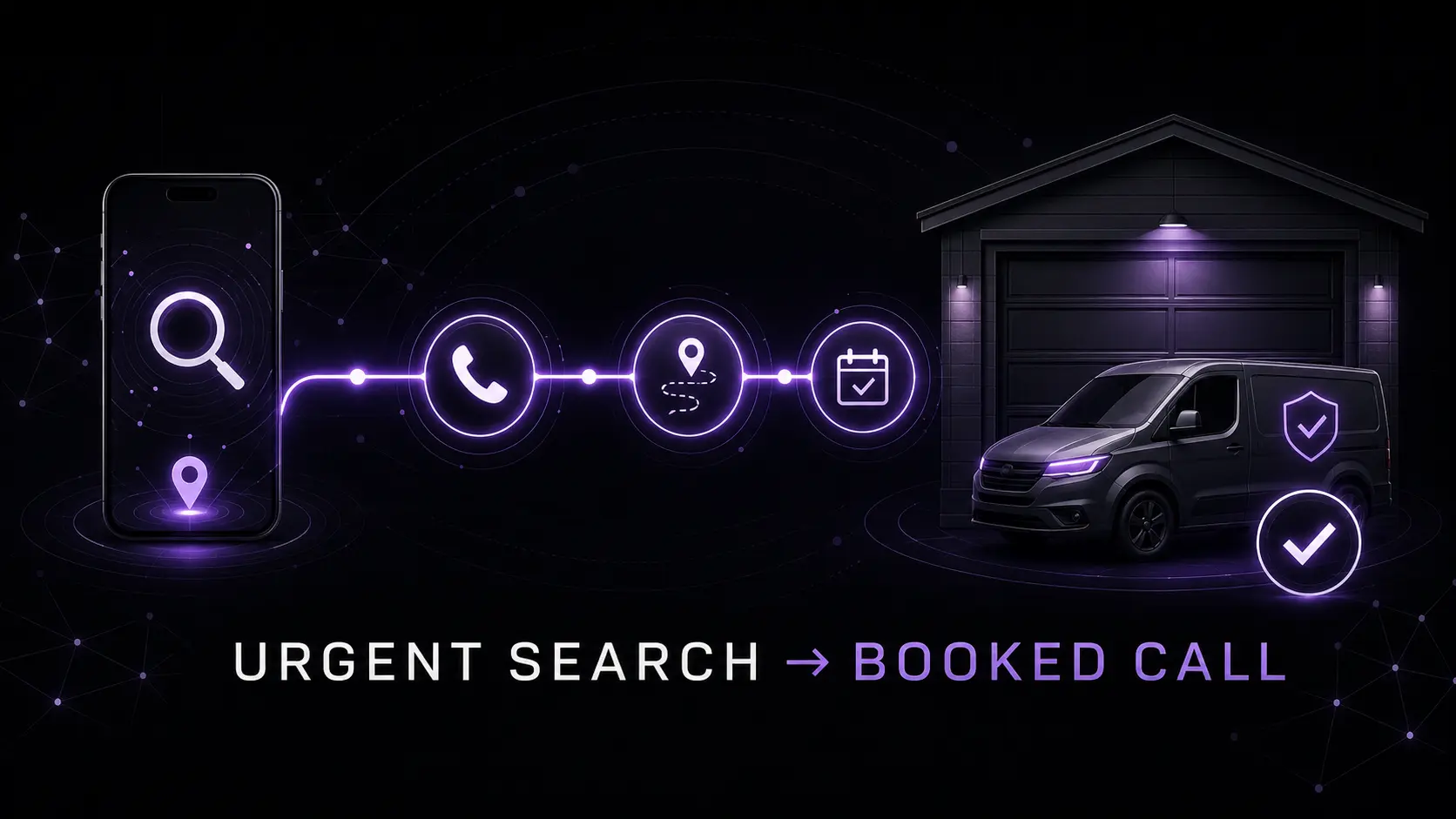
A homeowner with a door stuck open is not browsing casually. They need to know whether you answer, whether you handle the problem, and what to do next. The fastest SEO win is not always another ranking. It is removing uncertainty between the urgent search and the qualified call—without claiming 24/7 service your operation cannot consistently deliver.
01
The answer: optimize the decision before adding more traffic
Emergency garage door repair SEO has two jobs. The first is discoverability: helping the right service page and Business Profile appear for a relevant local search. The second is call readiness: giving the homeowner enough accurate information to act now. A company can succeed at the first and still lose the job on the second.
EdgeLocal viewpoint: rankings without qualified calls are incomplete. Before investing in another city page or keyword variation, test the journey from a mobile search result to an answered, properly qualified call. That path should be quick, calm, and honest.
This does not mean turning the page into a wall of red warnings or repeating “emergency” in every heading. It means answering the few questions that block action: Are you available? Do you handle this problem? Do you serve this location? Can I trust you? How do I reach you?
02
Make the mobile call path obvious and fast
Google uses the mobile version of a site for indexing and ranking, and its Core Web Vitals measure loading performance, responsiveness, and visual stability. Those facts do not prove that a faster page will automatically outrank every competitor. They do support a practical rule: build the urgent journey for the phone in the homeowner’s hand, then make it stable and responsive.
Put a clear tap-to-call action near the opening answer. Repeat it after the problem-fit section and again near the final decision point. Keep the phone number readable as text. Avoid a full-screen popup that hides the page, and do not let a sticky call bar cover pricing context, safety guidance, or form controls.
Then test the page on a real phone over cellular data. If the main image, font, or third-party widget delays the first useful content, simplify it. The goal is not a perfect lab score at the expense of clarity. It is a page that becomes useful immediately and stays easy to operate.
03
Use truthful availability instead of decorative 24/7 claims
A “24/7” badge is valuable only when someone can reliably answer, qualify, and route the call at that time. If overnight calls go to voicemail until morning, state the real phone hours and set an accurate expectation for callbacks. If an answering service qualifies calls after hours, explain what it can and cannot schedule.
Google provides controls for regular and special Business Profile hours. The website, Business Profile, call handling, and ad copy should tell the same accurate story. Review holiday and seasonal exceptions before they create the worst possible experience: an urgent customer seeing “open,” calling repeatedly, and receiving no answer.
Use concrete language such as “Calls answered until 9 p.m.” or “After-hours requests are reviewed beginning at 7 a.m.” only when operations support it. EdgeLocal treats this as a trust and conversion decision, not a keyword tactic.
04
Help homeowners identify the problem without inviting a risky repair
Urgent pages should name recognizable symptoms: the door is stuck open, a spring appears separated, a cable looks loose, the door is off track, the opener runs without moving the door, or the door will not close. This helps a visitor recognize that the company handles the situation and gives dispatch a cleaner starting point.
Do not turn that section into repair instructions. DASMA notes that extension springs are under high tension and recommends a dealer safety inspection when required safety cables are missing. Springs, cables, an off-track door, and a heavy door that may fall should be handled by a qualified garage door professional.
A useful page tells the homeowner how to avoid making the situation worse: keep people and vehicles away from an unstable door, do not force it, and call a trained professional. It can educate without teaching a hazardous procedure.
05
Design the first call as part of the conversion system
The website has not converted an urgent search simply because the phone rang. The first response should identify whether the lead fits the service area, schedule, and technician capability. Give whoever answers a short intake sequence: location, door state, visible symptom, whether a vehicle is trapped, preferred timing, and a safe callback number.
Do not promise an arrival window the schedule cannot support. A slightly longer but reliable expectation protects trust better than a dramatic promise followed by silence. If the caller falls outside profitable coverage, give a clear answer quickly instead of leaving them waiting.
The same logic applies to forms. Keep emergency forms short, label the response expectation, and never make a homeowner complete a long project questionnaire before revealing whether anyone is available.
- Track calls answered during the stated hours.
- Track qualified calls, not every ring or form submission.
- Track booked jobs and the reasons good leads were not booked.
- Compare performance by service, time of day, and real service area.
06
Build the EdgeLocal urgent-search system
Start with one strong emergency-repair page connected to the relevant repair services, not a network of thin “emergency garage door repair” city pages. The page should explain genuine coverage, problems handled, availability, trust evidence, safety boundaries, and the call path. If a market later earns a distinct page, give it real operating evidence and a unique job within the site.
Align the Business Profile with the same service and availability facts using the free Google Business Profile checklist. Connect the page to the broader garage door SEO system, and compare the target market with the company’s real service and visibility radii.
Finally, use the ROI calculator to model the commercial consequence with your own inputs. Measure the change in qualified calls and booked work after the call-path fixes. If the business cannot answer or fulfill more urgent demand yet, repair that operating constraint before buying more visibility.
Reviewed July 23, 2026. Google documentation supports the platform and mobile-experience facts. DASMA supports the safety boundary. The 60-Second Urgent-Call Test, conversion diagnosis, and commercial recommendations are EdgeLocal analysis.
Sources and methodology
Sources checked for this guide
Source links support the platform, search, or safety facts stated above. The diagnostic framework and commercial recommendations are EdgeLocal analysis.
Put a value on the leak
Model what a better urgent-call path could be worth.
Use the free ROI calculator with your own average job value, close rate, and margin. It is an operating model—not a promise—designed to show whether recovering more qualified calls deserves priority.
Calculate the opportunity