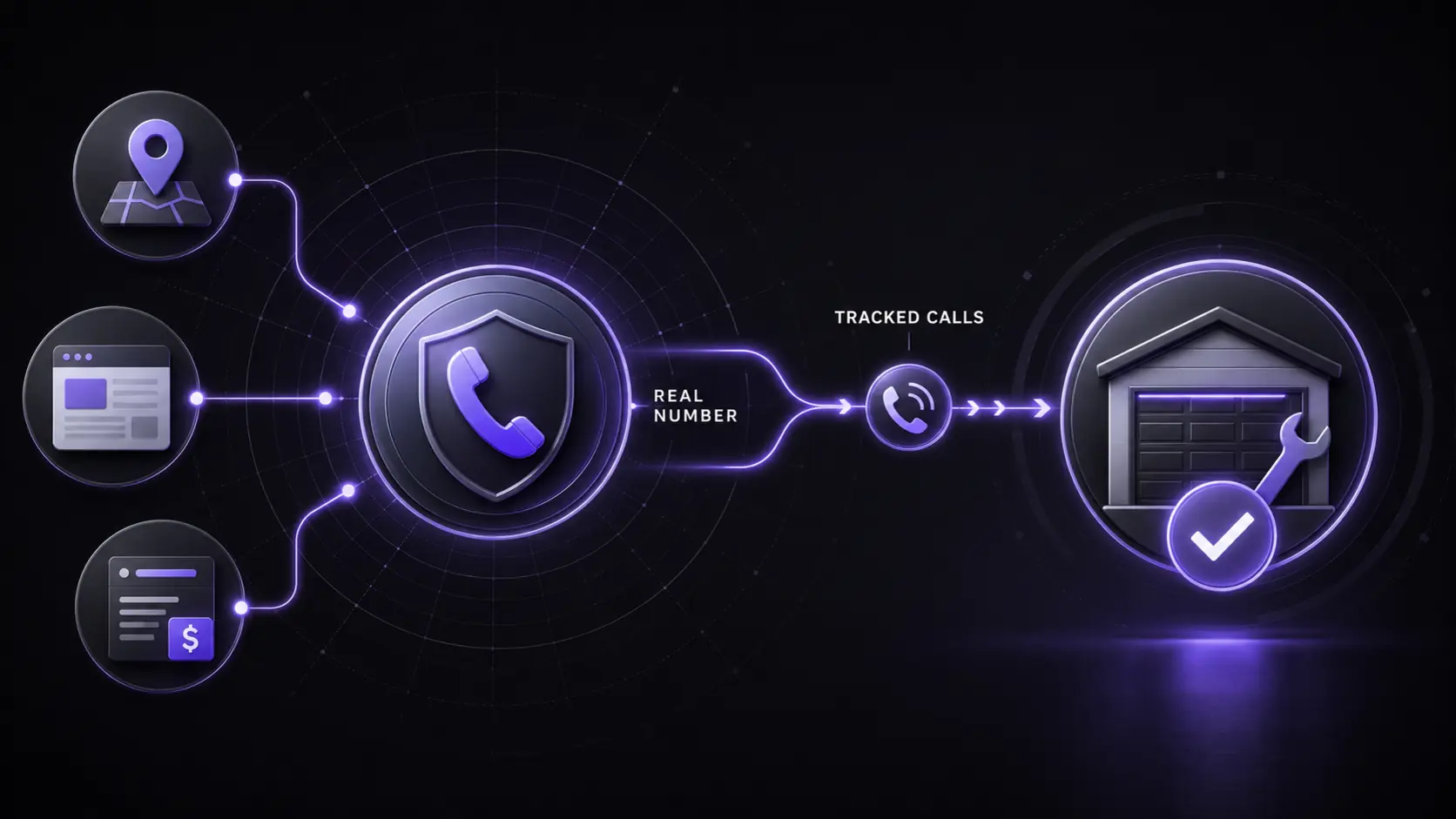
Garage door companies need to know which searches produce calls, but careless call tracking can replace a durable business number with temporary numbers across the web. The answer is not to abandon attribution. It is to govern every number: preserve a controlled canonical line, use forwarding only in defined contexts, connect calls to qualified outcomes, and make sure customers, search platforms, and dispatch all reach the same real operation.
01
The answer: keep identity stable and attribution controlled
Choose one durable business number that the company controls and can retain. Treat it as the canonical operational line. It should reach the correct office, work during the hours the business represents, and survive changes in agencies, ad platforms, tracking vendors, and website providers.
Then add attribution in controlled layers. A Business Profile tracking number, dynamic website number, or advertising forwarding number can be useful when it routes reliably and its purpose is documented. The mistake is allowing temporary numbers to spread into directories, schema, social profiles, vehicles, printed materials, and customer contacts without governance.
EdgeLocal viewpoint: measurement should clarify the customer journey without making the business harder to identify or reach. One tracking number does not automatically destroy local rankings, but unmanaged numbers create avoidable identity, routing, ownership, and reporting problems.
02
Start with the number the business truly owns
Google’s Business Profile guidelines say the phone number must be under the direct control of the business. Google also allows a primary number plus up to two additional phone numbers. That creates room for measurement, but it does not remove the need for a durable underlying line.
Before changing anything, document the legal or account owner, carrier, porting rights, destination, call tree, business hours, voicemail behavior, text-message capability, and recovery process. Test the line from outside the office and verify that caller information reaches the team correctly.
Do not let an agency or software account become the only place where the company’s public number exists. If the relationship ends, the business should not lose the number customers saved, reviewers referenced, or Google associated with the operation.
03
Separate a phone click from a qualified call
A click on a telephone link proves that a visitor activated the link. It does not prove the call connected, reached the correct team, involved a service the company handles, or became a booked job. Label that event honestly as a phone click.
Call-reporting platforms may provide connected-call details such as source, start time, duration, answer status, or recording when configured lawfully. Those fields still do not establish commercial value. Dispatch or the CRM needs to classify service requested, ZIP code, qualification, booking, expected value, completion, and final revenue.
Google Ads supports several phone-call conversion methods, including calls from ads, website call tracking with Google forwarding numbers, and imported call conversions from another system. Google notes that imported conversions can let advertisers count calls based on more meaningful outcomes, such as sales. That is closer to the decision a garage door owner actually needs.
04
Keep forwarding numbers inside their intended context
Google explains that its forwarding numbers route calls to the actual business line while enabling advertising reports. It also says those numbers are Google’s property, may change or be reassigned, and should not be promoted outside Google Ads call reporting or website call conversion tracking.
Apply the same governance principle to any tracking provider. Know whether the company can port the number, how long it remains active, what happens when billing stops, and where it has been published. Never copy a temporary advertising number into permanent citations simply because it appeared during a test.
Dynamic number insertion on a website should have a stable default number, defined attribution sessions, reliable routing, and a fallback when scripts or cookies fail. Keep the visible contact path usable for every visitor, including people who block scripts or arrive outside the tracked campaign.
05
Align the profile, website, schema, and dispatch reality
Google’s LocalBusiness documentation describes the telephone property as the primary contact method and recommends including the country code and area code. Structured data should represent the visible, real business information on the page, not a hidden attribution experiment.
Review the number shown in the header, footer, contact page, service pages, location pages, Business Profile, major directories, LocalBusiness schema, ad assets, and call-routing system. The objective is not mechanical sameness at every cost. It is a coherent explanation of which number represents the business and which numbers exist only to measure a controlled source.
Connect this review to the Google Business Profile guide, the urgent-call conversion test, and the paid-versus-owned demand framework. The customer should encounter one accurate business story from search result to answered call.
06
Run the EdgeLocal monthly call-integrity review
Once a month, place test calls through every active source number. Confirm the correct destination, caller experience, answer behavior, voicemail, recording or disclosure behavior when applicable, attribution source, and CRM record. Retire orphaned numbers only after checking where they remain published and planning a safe transition.
Report a short commercial funnel: calls, answered calls, qualified calls, booked jobs, completed jobs, booked value, gross profit, and reasons leads were lost. Break it down by channel, service, and profitable coverage area. The service-radius diagnostic helps distinguish valuable nearby demand from expensive out-of-area activity.
Use the ROI calculator to model the consequence of better answer and booking rates. If tracking says one channel produces many calls but few profitable jobs, fix targeting or qualification before celebrating the lead count.
Reviewed July 30, 2026. Google documentation supports the Business Profile, forwarding-number, call-conversion, and structured-data facts. The Number Governance Map and operating recommendations are EdgeLocal analysis. Phone recording, consent, retention, and privacy obligations vary; obtain appropriate legal guidance for the jurisdictions and technologies involved. Tracking does not guarantee rankings, leads, bookings, or revenue.
Sources and methodology
Sources checked for this guide
Source links support the platform, search, or safety facts stated above. The diagnostic framework and commercial recommendations are EdgeLocal analysis.
Measure the call economics
Turn tracked calls into a qualified-revenue model.
Use the free ROI calculator with your actual qualified leads, close rate, booked job value, gross margin, and plan cost. A phone ring is the beginning of the measurement, not the result.
Run the free ROI calculator