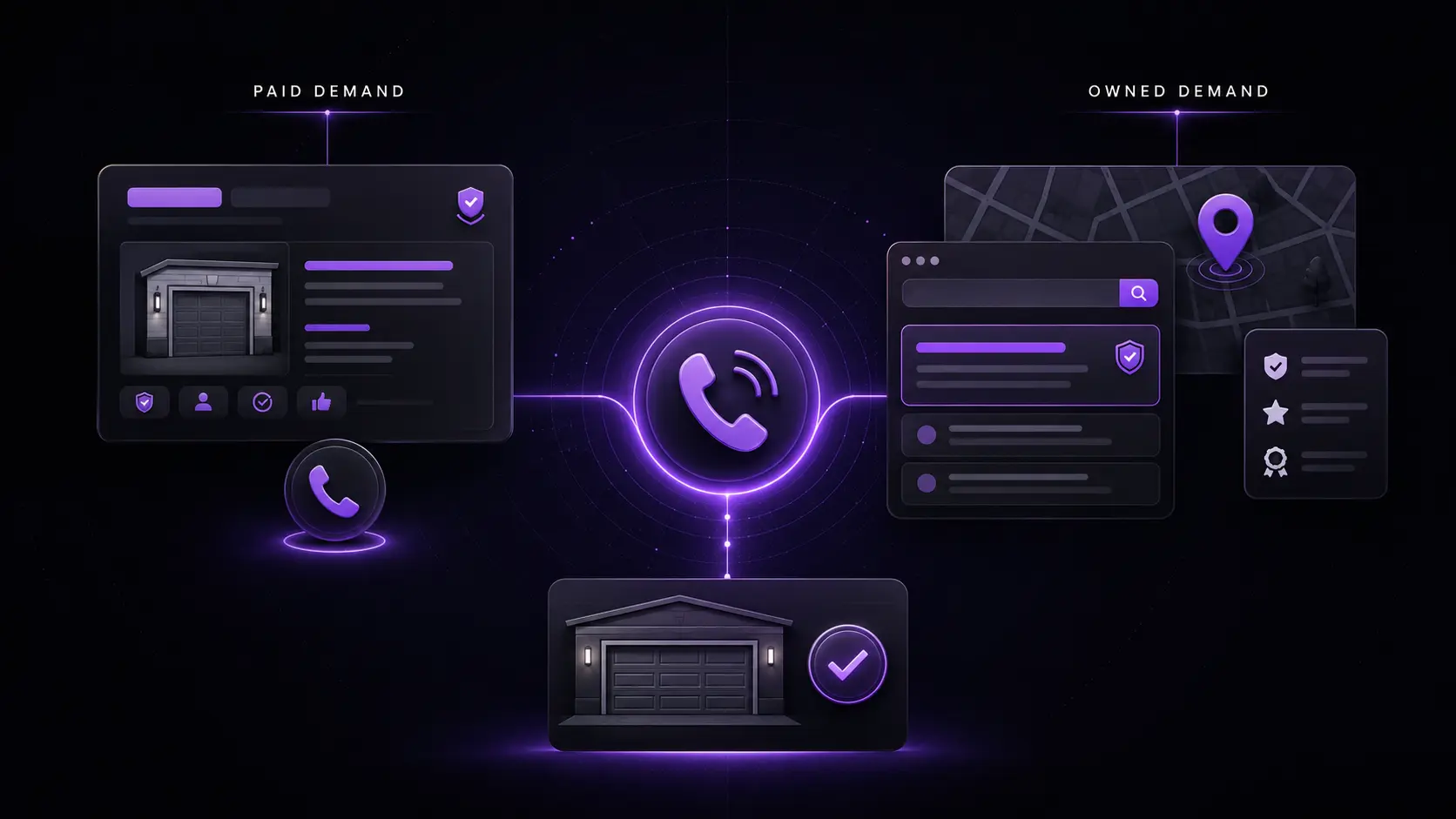
Local Services Ads can put a garage door company in front of urgent homeowners quickly. SEO can build visibility that remains useful when an ad budget pauses. The expensive mistake is treating either channel as a complete growth system. They solve different parts of demand capture, use different controls, and should be judged against the same commercial outcome: qualified, profitable booked work.
01
The answer: buy speed, build ownership, measure one outcome
Use Local Services Ads when the operation can answer and fulfill additional demand now. Use SEO to build a clearer, more durable discovery system across the website and Google Business Profile. Do not expect ad spend to improve organic rankings, and do not expect a newly optimized site to replace paid lead flow overnight.
Google explicitly says advertising with Google does not affect a site’s presence in organic search results. Local Services Ads and SEO may appear on the same search journey, but money paid into one system does not purchase authority in the other.
EdgeLocal viewpoint: paid demand and owned demand should share one scorecard. If a channel produces calls that are unqualified, unanswered, outside profitable coverage, or rarely booked, its visible lead count is incomplete.
02
Know what Local Services Ads actually control
Google says Local Services Ads can generate phone and message leads, and provides tools to manage leads and bookings. Participation is not simply a matter of switching on a campaign. U.S. providers must complete the screening and verification requirements applicable to their category and location, which may include identity, business, license, insurance, or background checks.
Inside the account, service areas and job types shape eligibility. Google also documents a broad-search setting that can expose an advertiser to general category searches even when a specific service is not named. Garage door operators should review those settings against the work they actually want, rather than assuming every lead in the category is equally valuable.
That control creates speed, but it creates operating responsibility too. Hours, service coverage, job types, response behavior, and the real dispatch operation need to agree. Turning on more territory without the capacity or margin to serve it can increase activity while weakening the business result.
03
Understand what SEO owns that advertising cannot buy
SEO improves how search engines access, understand, and present a company’s own information. That includes service pages, legitimate location content, internal links, technical foundations, review evidence, Business Profile accuracy, and the mobile path from search to contact.
Google’s SEO Starter Guide describes SEO as helping search engines understand content and helping users decide whether to visit. Google does not accept payment for organic inclusion or rankings. That boundary is commercially important: an LSA budget can rent prominent exposure, but it cannot purchase a stronger organic position.
Owned visibility is not free and it is not permanent. Useful content takes research and maintenance; technical errors can block discovery; competitors improve; and rankings fluctuate. The advantage is that a well-built page, accurate profile, and coherent site architecture can keep supporting discovery across multiple searches without a fee attached to each organic click or call.
04
Diagnose the mix with job economics, not channel loyalty
Start with the next operational constraint. If technicians have open capacity and the phone team converts urgent inquiries well, paid demand may fill the schedule faster. If cost per booked job is rising, lead quality is inconsistent, or the company disappears when budget pauses, owned visibility deserves more attention.
Separate lead volume from qualified demand. For each channel, track the lead source, service requested, location, whether the call was answered, whether the job fit, whether it booked, expected revenue, gross margin, cancellation, and final disposition. Use the same definitions so paid and organic performance can be compared honestly.
Do not credit every branded search to SEO or every phone call near an ad impression to advertising. Ask callers how they found the business when appropriate, preserve channel-specific tracking, and look for assisted journeys. A homeowner may see an LSA, check reviews, visit the website, and call later from the Business Profile.
05
Build a shared truth layer across ads, profile, and website
The company name, services, coverage, hours, credentials, reviews, and response expectations should tell one accurate story wherever the customer encounters them. Misalignment creates both waste and distrust: an ad attracts a service the website barely explains, the profile lists different hours, or dispatch rejects a city that appears covered.
Review LSA job types beside the website’s service architecture. Compare ad service areas with the service-radius reality check, not with the largest circle the team could theoretically drive. Use the Google Business Profile checklist to align profile facts, and strengthen the mobile response path with the emergency-repair conversion guide.
A small set of excellent service and market pages can support this truth layer better than dozens of thin city variants. The location-page framework explains when a market deserves its own page and when consolidation is safer.
06
Use the EdgeLocal two-channel operating review
Every month, review four questions. First, where did qualified demand originate? Second, which services and ZIP codes produced booked gross profit? Third, where did leads fail between first contact and completed work? Fourth, what asset or setting should change next?
For Local Services Ads, the change might be tighter job types, realistic service areas, improved answer coverage, or a different budget allocation. For SEO, it might be a stronger buyer-intent service page, better internal linking, corrected profile facts, more useful review evidence, or removal of overlapping pages.
Then model the opportunity with the ROI calculator. The goal is not to declare advertising or SEO universally superior. It is to use paid exposure for intentional speed while building accurate assets the company controls.
Reviewed July 29, 2026. Google documentation supports the Local Services Ads, verification, account-control, and organic-search facts. The Demand Ownership Matrix, channel diagnosis, and commercial recommendations are EdgeLocal analysis. Availability, screening, lead pricing, and results vary by category, location, account, competition, and operations; neither channel guarantees leads, rankings, bookings, or revenue.
Sources and methodology
Sources checked for this guide
Source links support the platform, search, or safety facts stated above. The diagnostic framework and commercial recommendations are EdgeLocal analysis.
Compare both channels in dollars
Model the qualified-call economics before changing the mix.
Use the free ROI calculator with your actual lead volume, close rate, average booked job value, and gross margin. Compare channels on profitable work, not dashboard activity.
Run the free ROI calculator